
It is clear that groups are strange animals.
They never act as foreseen, they disrupt, they can be running amazingly for weeks and suddenly fully dysfunction for one small (perceived) parameter change. And that is fab!
What is key is to remember few concepts:
The Tuckman one:
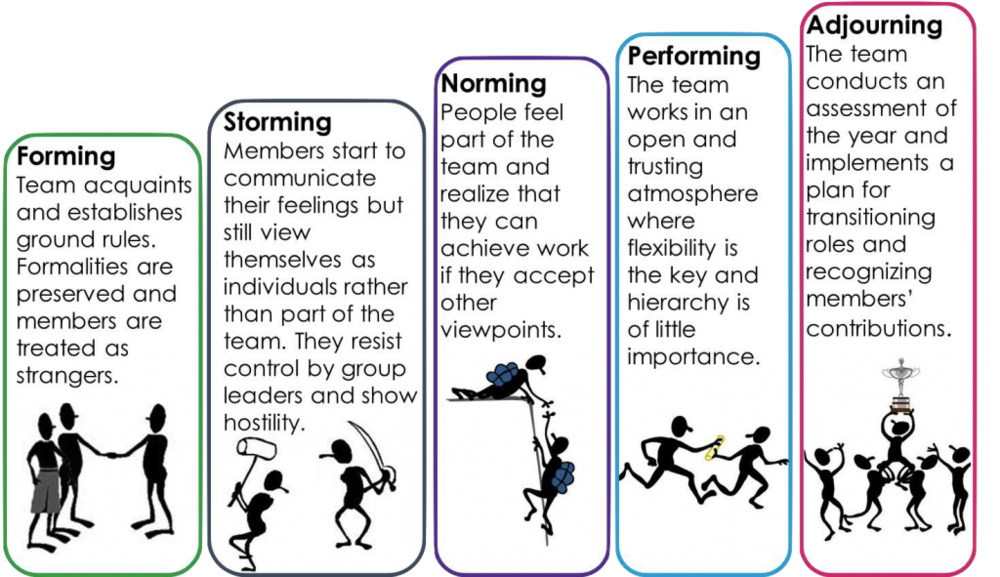
Stage 1: Forming. In the forming stage, personal relations are characterized by dependence.
Stage 2: Storming. The next stage, which Tuckman calls storming, is characterized by competition and conflict in the personal-relations dimension an organization in the task-functions dimension.
Stage 3: Norming. In Tuckman’s norming stage, interpersonal relations are characterized by cohesion.
Stage 4: Performing. The performing stage is not reached by all groups. If group members are able to evolve to stage four, their capacity, range, and depth of personal relations expand to true interdependence.
Stage 5: Adjourning. Tuckman’s final stage, adjourning, involves the termination of task behaviors and disengagement from relationships.
I think that the stage are not always sequential. Because what lives the group is often messy. Groups cycle through the phases throughout their process. What can be almost always witnessed is that when a group is newly formed, you can foresee a storming session! It is a huge advantage to know that this phase is quite usual. The question will then be: How well will you manage the tensions or conflicts? A key aspect to keep the process going and not to damage to object supposed to be build by the group.
A worst case is to my knowledge what we call Groupthink.
Why? It is the moment when a group of people are not thinking or are all thinking the same:

The idea is that groupthink is a kind of thinking in which maintaining group cohesiveness and solidarity is more important than considering the facts in a realistic manner. It occurs when a group of well-intentioned people make irrational or non-optimal decisions that are spurred by the urge to conform or the discouragement of dissent. In the interest of making a decision that furthers their group cause, members may ignore any ethical or moral consequences. The group is sort of reduced to one collective mind. Usually the leader is too directive and thus inhibiting alternatives. To stop this you need to encourage debate, look for different personalities, acknowledge biases, and reach out!
Finally, let’s quickly mention the Karpman Triangle:

The Victim: The Victim’s stance is “Poor me!”. The Victim feels oppressed, helpless, hopeless, powerless, ashamed, and unable to make decisions, solve problems, take pleasure in life, or gain insight. If not being persecuted, the Victim will seek out a Persecutor and also a Rescuer who will save the day—yet also reinforce the Victim’s negative feelings.
The Rescuer: The Rescuer’s line is “Let me help you.” A classic enabler, the Rescuer feels guilty if they don’t intervene. Yet this rescuing has negative effects: it keeps the Victim dependent and gives them permission to fail. The hidden payoff is that the Rescuer avoids focusing on their own anxieties and issues by centering their energy on others. Concern for the Victim’s needs often disguises avoidance of their own problems.
The Persecutor: The Persecutor insists, “It’s all your fault.” Controlling, blaming, critical, oppressive, angry, rigid, and superior, the Persecutor embodies the role of the oppressor (source: Wikipedia).
Two crucial things to understand about the Triangle:
- These roles are not authentic behaviors. The Drama Triangle is a kind of role play that people adopt in certain situations.
- Everyone has at least one role they feel comfortable in (often unconsciously), and most of us have one role we automatically step into when challenges arise.
The way out?
Recognize when you slip into one of these roles, and reframe it:
The Victim ? becomes the Creator (accept vulnerability, look for options)
The Rescuer ? becomes the Coach (“How can I help you?” instead of taking over)
The Persecutor ? becomes the Challenger (assertive, constructive way to meet needs)
The key? Self-awareness!